
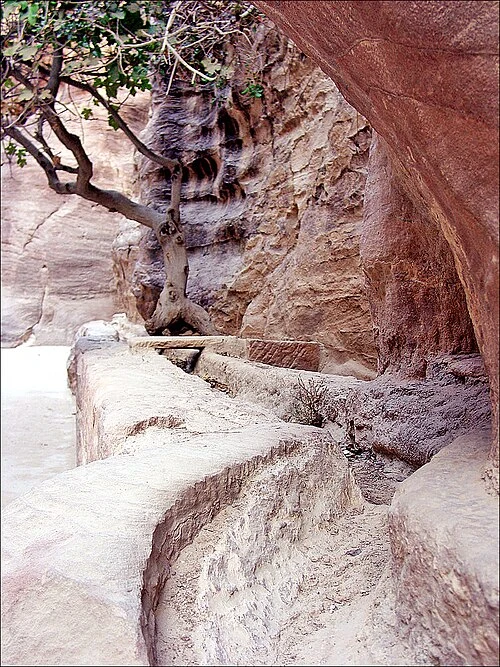

Water is a useful subject to carry through Petra because it changes what counts as a landmark. A channel beside a path, a cut through rock or the edge of a collecting structure can become as interesting as a monumental facade. These features invite you to think about the work needed to sustain a settlement.
UNESCO’s account of Petra includes channels, diversion works, cisterns and reservoirs among the city’s significant remains. The point is the relationship between them: collecting water, directing it and retaining it required more than one isolated invention. Petra’s architecture and its landscape cannot be understood entirely separately from these practical systems.
Start with one visible detail
The Siq interpretation identifies channels on both sides of the gorge and a tunnel near its entrance built to divert floodwater. The small channel in our opening photograph belongs to that wider engineering context. Its visible stone cover provides a useful question: which parts of an ancient system were protected, exposed or maintained?
A photograph cannot show the full course, date or function of every cut in the rock. Avoid identifying an unfamiliar groove from appearance alone. Use on-site interpretation or a knowledgeable guide to connect a feature to the current archaeological account. If an answer is uncertain, record it as a question.
Compare the detail with the city
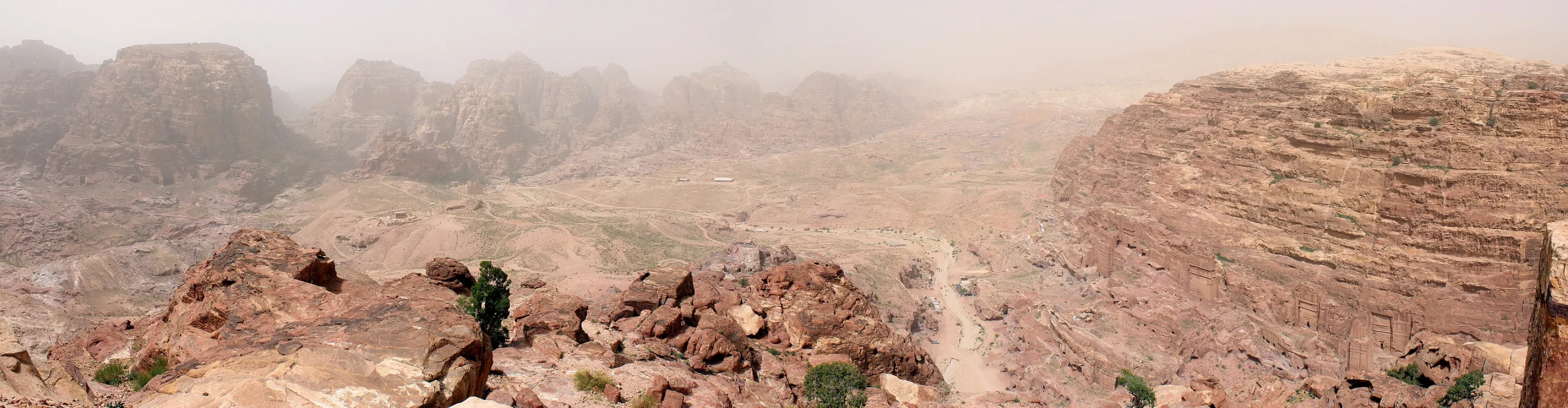

The panoramic photograph changes the scale of the question. Instead of asking how a channel was cut, consider the needs of a whole settlement: people, movement, buildings and the management of changing conditions. This is an editorial way to look, not a reconstruction of an exact ancient daily routine.
Make a simple note with three columns. It can help keep a careful distinction between evidence and imagination:
| What you see | What a source explains | What remains a question |
|---|---|---|
| A channel edge | A stated purpose or connection | How a missing section continued |
| Separate stone blocks | A construction phase, if identified | Which repairs are modern |
| A change in level | The interpreted flow direction | How the feature was maintained |
Look without adding wear
Material detail rewards close attention, but that does not require physical contact. Move your viewpoint from the permitted path and use a camera’s framing rather than climbing onto an edge. Leave stones and fragments where they are. A portable “souvenir” removes part of the context that gives a place meaning.
When you speak with a guide, ask how conservation changes what visitors can see. A protective intervention may be less photogenic than bare stone, but appearance alone is a poor measure of what helps a site survive. Do not interpret every modern addition as a defect or every weathered surface as untouched antiquity.
Carry the question beyond the visit
The authority’s Petra Five Promises includes care for limited water resources. That contemporary concern is not identical to ancient engineering, but it is a reason to treat water as part of a living regional landscape. Back in Wadi Musa, think about the ordinary resources behind your stay as well as the monuments you photographed.
Pair this material-focused visit with the wider ancient-city guide. One carefully observed channel and one broad city view can make a stronger memory than a collection of unconnected facades.